Two simple strategies—nonverbal hand signals and conversation stems—can transform classroom discussions into spaces where every student feels empowered to participate.
By: Joy Roberts| Friendzy Co-founder
The start of the school year is full of possibilities. Fresh notebooks, clean bulletin boards, and a new group of students ready to learn and grow together. But here’s the thing—before we dive into academics, we have an incredible opportunity to set the tone for our classroom culture. We can give students tools to speak up, listen deeply, and engage with one another respectfully from day one.
Two simple strategies—nonverbal hand signals and conversation stems—can transform classroom discussions into spaces where every student feels empowered to participate.
Nonverbal hand signals are a game-changer for creating equitable participation. They give students a safe, low-pressure way to express agreement, disagreement, or curiosity without interrupting. This allows you to see what the majority of your students are thinking—if more than half agree with an incorrect answer, you know it’s time to reteach.
Conversation stems build on this by giving students language to express themselves with clarity and respect. They model how to agree, disagree, add on, or ask for clarification in a way that keeps the dialogue productive.
When used together, hand signals and conversation stems create a classroom environment where students hold one another accountable, listen actively, and share meaningful ideas.
Step One: Start simple with “agree” and “disagree” signals.
Put a lighthearted question on the board like “I think cats are better than dogs.” Have students silently respond with a hand signal, then use a sentence stem to explain:
“I disagree with Ms. Patel because my cat doesn’t cuddle like a dog—she scratches me instead.”
Step Two: Add the “add on” signal.
Once students are comfortable with “agree” and “disagree,” introduce “add on” and practice using it with a variety of sentence stems. Encourage them to stretch beyond the same go-to response.
Step Three: Introduce the final three—clarify, prompt, and explain.
Wait until students can carry a conversation before adding these. Introduce them one at a time, giving plenty of practice before layering on more complexity. Trust your teacher instincts and circle back for review as needed.
Friendzy has created ready-to-use resources to help you implement these tools right away—desk tags, bookmarks, and posters that make the stems and signals easy for students to reference. In my class, bookmarks lived in the top corner of desks for quick access, and we glued conversation stems into journals for a permanent reminder.
These small, daily practices at the beginning of the year help you build a culture of respectful dialogue that lasts all year long. Students gain confidence, learn to truly listen, and develop skills they’ll carry into every subject—and every relationship—beyond your classroom.
At Friendzy, our approach to character development education is deeply rooted in faith in action. We believe these aren’t merely "soft skills," they're skills for good, skills for life.
We teach students that emotional awareness means engaging with critical thinking, being intentional, and staying rooted in their identity in Christ—even amid uncertainty.
Ready to strengthen your school’s character education and faith foundation this fall? Learn more about Friendzy’s program for faith-based schools and discover tools that support whole-child formation rooted in Biblical truth.
Let’s work together to empower your staff and students with skills for good, skills for life.
👉 Reach out now to schedule a conversation — we’d love to share how Friendzy can support your school community!
Download the hand signals and conversation stems resources today, and watch your classroom transform into a place where every voice matters.
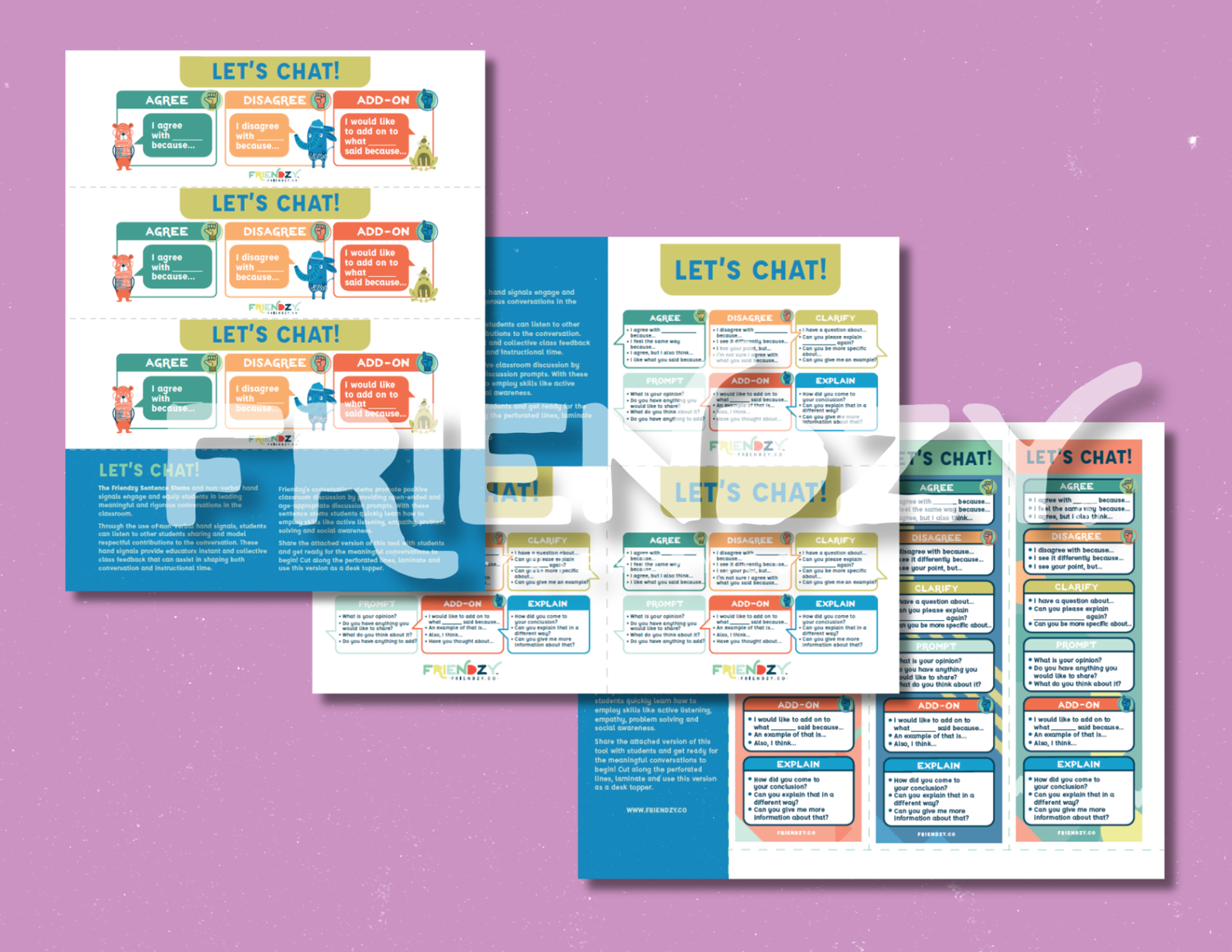
STEP ONE: Introduce the "agree" and "disagree" hand signals (these are the easiest to grasp). Put a fun question on the board like "I think cats are better than dogs," then have students agree or disagree with the statement using hand signals. Next, have students share using sentence stems: "I disagree with Ms. Wei because my cat does not like to cuddle like a dog does and instead scratches me."
STEP TWO: After your students master the step above and no longer need prompts, continue the conversation with "add on." Practice the hand signal and the sentence stem. I would like to mention that when I first started this, my students were only choosing one sentence stem for each category. Challenge your students to try a variety of sentence stems once they are comfortable!
STEP THREE: When your class is comfortable with "agree." "disagree" and "add on" add the last three categories: clarify, prompt, and explain. I didn't introduce these last categories until I was sure my students could carry the conversation. Take your time to introduce each category individually. Of course, use your teacher intuition, and don't be afraid to go back to practicing if your students need it!
BIO | Joy Roberts - Friendzy Co-Founder

Joy Roberts, Ed.D, is a passionate entrepreneur, curriculum designer, speaker, teacher, character development advocate, and co-founder of Friendzy. Witnessing the growing disconnect among children in an increasingly digital world, Joy and her co-founder, Julie Widman, Ed.D, set out to address the social crisis affecting today’s youth.
In a world where loneliness, isolation, and unkind words are commonplace, she is committed to equipping a generation of students on how to be really good friends. By integrating research-backed, whole-school programming into both faith-based and public schools, Joy guides Friendzy toward fostering character development while strengthening school communities.
With a Bachelor’s in Business Management and Marketing from Washington State University, a Master’s in Theology from Western Seminary, and a Doctorate in Educational Leadership from Marymount University, Joy combines her expertise in education, leadership, and faith to empower students, educators, and families with the tools needed to build meaningful, lasting relationships.