Friendzy empowers rural schools to enhance emotional growth and character development by leveraging their close-knit communities to deliver impactful whole-child learning experiences.
Rural school districts across the United States often face challenges in gaining recognition compared to their larger metropolitan counterparts. With smaller populations, these districts tend to receive less funding, even though they serve approximately 20% of the nation's student population (González et al., 2021).
Despite these challenges, rural schools possess unique strengths. Their close-knit communities allow schools to foster meaningful relationships with students and their families, creating a personalized and empathetic educational experience.
This community-focused approach often helps rural students perform as well as, or better than, their peers in larger districts on tests and assessments.
Friendzy excels in supporting schools that value community connections. When tasked with enhancing whole-child learning experiences, Friendzy has consistently delivered remarkable results, particularly in environments where a strong sense of community is central to student success (Redding & Walberg, 2012).
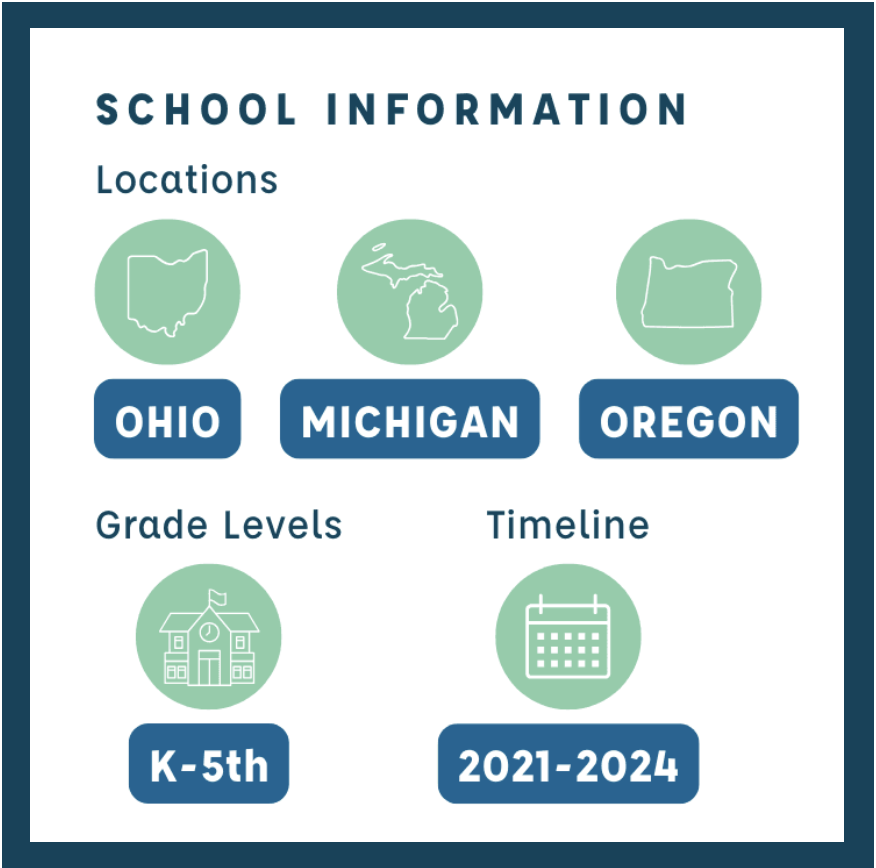
In rural school districts across Michigan, Minnesota, and Oregon, educators faced growing challenges in supporting K-5 students as they navigated the social and emotional complexities of early childhood. With limited resources, schools were seeing an increase in:
Behavioral issues
Attention difficulties
Emotional struggles
To address these needs, the districts adopted Friendzy, a program focused on character development and emotional resilience, uniquely tailored to fit the needs of their communities.

From 2021 to 2024, Friendzy partnered with select rural schools to provide an evidence-based framework for developing critical emotional and social skills. The programatic efficacy and student growth was measuring using Insights Assessment (McKown, 2017).
2,573 student responses were collected
Biannual assessment participation was implemented to highlight meaningful growth
Norm-referenced scores and percentile rankings provided a clear roadmap for success
Growth was measured in key areas like self-control, emotional recognition, and overall emotional competence
This biannual assessment offered norm-referenced scores and percentile rankings, providing a clear roadmap for success.
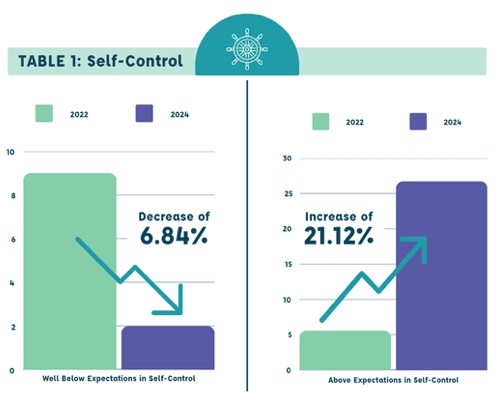
Friendzy equipped students with practical tools to manage emotions, regulate impulses, and navigate social interactions. The impact was profound:
Students scoring Well Below Expectations in Self-Control dropped from 8.79% (2022) to 1.95% (2024).
Students scoring Above Expectations soared from 5.61% to 26.73% over the same period.
The use of the Friendzy program produced dramatic change leading to profound impact on teachers, peer relationships, and classroom dynamics: in a classroom of 30 students, the number struggling with self-control dropped from about 3 in 2022 to less than 1 in 2024.These gains create calmer, more focused classrooms where students can navigate emotions and conflicts with confidence. Self-control in the classroom is a crucial skill for students, impacting academic achievement and behavior management (Duckworth et al., 2019).
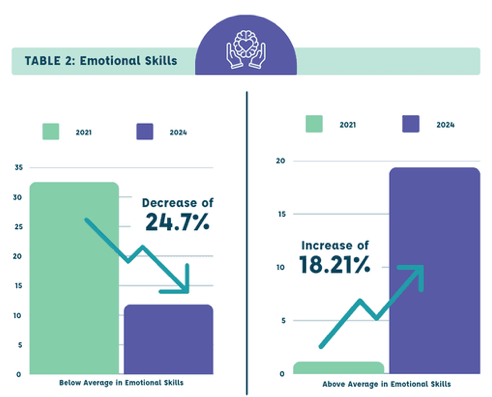
From 2021 to 2024, the Friendzy program improved student's emotional understanding and management:
Students scoring Above Average in Emotional Skills rose from 1.16% to 19.37%.
Those scoring Below Average dropped sharply from 32.56% to 11.86%.
In a classroom of 30 students, those excelling in emotional competence increased from just 1 student in 2022 to 6 students in 2024, while those struggling dropped from 10 students to 4. This shift significantly enhances classroom dynamics and peer interactions, with more students thriving emotionally. Friendzy’s adaptive curriculum, informed by teacher feedback, provided meaningful tools that evolved alongside students’ needs, driving significant emotional growth.
Empathy and emotional recognition are at the core of Friendzy’s program. Research indicates empathy is crucial in classrooms today, fostering a positive learning environment and promoting social connection (Swan & Riley, 2015; Franzese, 2017). The results were transformative:
Students Below Average in Empathy decreased by 24.02% over three years.
Those scoring Above Average saw year-over-year growth of 8.14% (2021-22), 9.53% (2022-23), and 11.71% (2023-24).
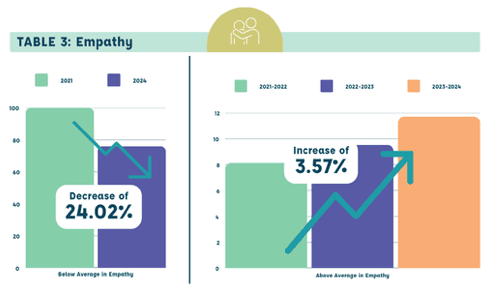
This growth yields a compassionate, connected classroom environment and lays the foundation for strong, positive relationships. Over three years, the number of students struggling with emotional recognition in a class of 30 decreased by approximately 7, while the number of students excelling in this skill increased steadily, with on average 3 more students joining the high-performing group each year. This steady improvement fosters a more supportive and emotionally aware classroom environment.

Friendzy equips students with life-changing skills. Increased self control, resilience, relationship skills and empathy prepare them for success in school and beyond. By reducing classroom disruptions and creating environments of support, Friendzy enables deeper learning and stronger connections.
In these rural communities, Friendzy isn’t just a program—it’s a transformative tool that creates supportive classrooms, fosters emotional growth, and builds meaningful friendships.
This isn’t just a program; it’s a movement. In rural schools across Michigan, Minnesota, and Oregon, Friendzy is shaping the next generation with the tools they need to lead meaningful lives—one classroom at a time.
Citations
Duckworth, A. L., Taxer, J. L., Eskreis-Winkler, L., Galla, B. M., & Gross, J. J. (2019). Self-control and academic achievement. Annual Review of Psychology, 70(1), 373–399. https://doi.org/10.1146/annurev-psych-010418-103230
Franzese, P.A. (2017). The Power of Empathy in the Classroom. Social Sciences Education eJournal.
González, A., Bernad, O., López -Teulón, M. P., Llevot, N., & Marín, R. (2021). Rural schools from its weaknesses to its strengths: Current analysis. Ehquidad Revista Internacional de Políticas de Bienestar y Trabajo Social, (15), 135–160. https://doi.org/10.15257/ehquidad.2021.0006
McKown, C. (2017). Social-emotional assessment, performance, and standards. Pp. 157–178 in S. M. Jones, E. Doolittle, & S. McLanahan (Eds.), The future of children: Special issue on social-emotional learning. Princeton, NJ: Princeton University Woodrow Wilson School of Public and International Affairs and the Brookings Institution. doi:10.1353/foc.2017.0008
Redding, S., & Walberg, H.J. (2012). Promoting Learning in Rural Schools.
Swan, P., & Riley, P. (2015). Social connection: Empathy and mentalization for teachers. Pastoral Care in Education, 33(4), 220–233. https://doi.org/10.1080/02643944.2015.1094120