Discover how Friendzy is transforming school climate for 3rd–5th graders through data-driven tools and character education. With measurable gains in safety, fairness, and belonging, this Impact Report shows how supportive classrooms lead to stronger academic and emotional outcomes.
Creating a positive school climate is essential for academic success, reducing disruptions, and fostering student wellbeing; and it is challenging work. Schools often face significant barriers in creating a positive climate that fosters safety, trust, and connection, especially for 3rd-5th graders navigating critical stages of character development (Erden, 2023; Ismail et al., 2023).
To address these issues, Friendzy schools utilize the Insights Climate Culture Assessment alongside their Friendzy program implementation. The Insights assessment identifies strengths and areas for improvement in safety, fairness, belonging, and instructional support.
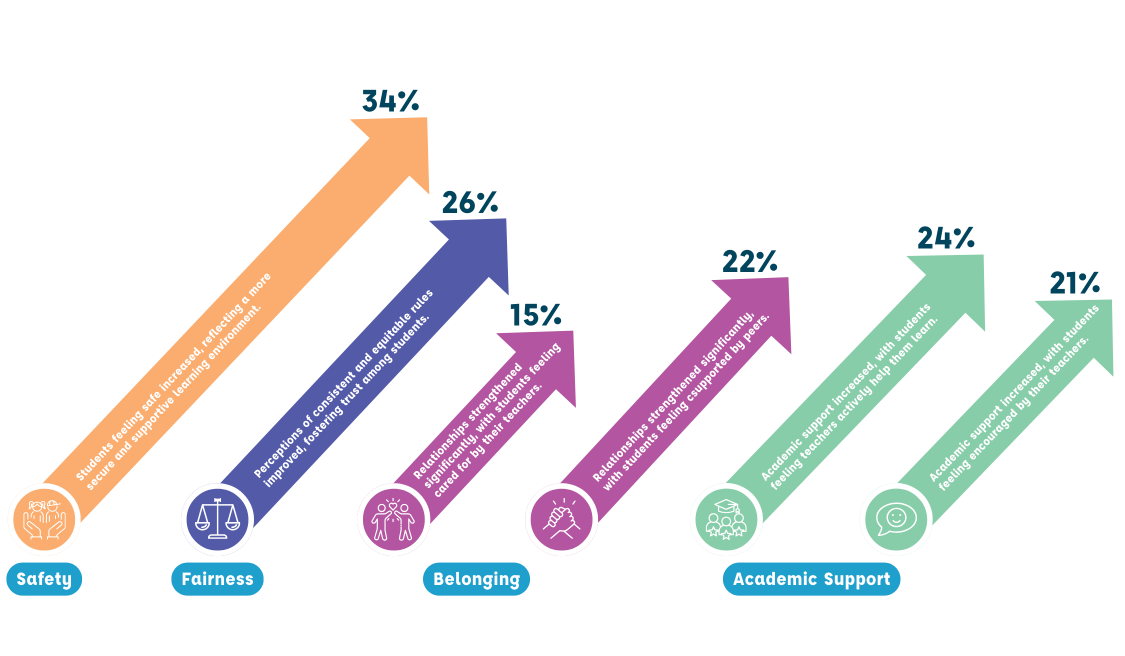
The Insights data reviewed in this impact report indicates significant transformation, including increased feelings of safety, improved perceptions of fairness, and a stronger sense of belonging. Academic engagement also grew, with students reporting more encouragement and instructional help from teachers. This data underscores the impact of intentional efforts to build connection and trust in the classroom.
Friendzy’s programs, praised by teachers for fostering kindness, compassion, and resilience, empower educators to create supportive environments where students thrive emotionally and academically. All students thrive in a positive school climate that respects individual differences and encourages active participation (Wulan & Sanjaya, 2022). Achieving this requires a holistic, long-term approach to create a sustainable, supportive environment (Martinsone et al., 2023). Central to this effort is the active role of teachers in establishing classrooms that foster inclusivity and connection (Brown, 2019).
This impact report highlights how a focused, data-driven approach can transform school climates into spaces where students feel valued, supported, and ready to learn.
— George, 5th Grade

To address these challenges, schools utilized the Insights Climate Culture Assessment (McKown, 2019); A tool designed to measure key aspects of the school environment, including safety, fairness, belonging, and instructional support. This data-driven approach highlighted strengths, such as teacher and peer relationships, and identified areas for targeted improvement.
Friendzy partnered with schools to provide programs and resources that build emotional and relational skills among students and educators. Together, they worked to foster a school culture grounded in connection, trust, and support. The leadership team at each school received customized Friendzy program implementation guidance designed to leverage their Insights data and increase students competency in measured social skills and overall wellbeing.
Students feeling safe increased by 34%, reflecting a more secure and supportive learning environment.
Perceptions of consistent and equitable rules improved by 26%, fostering trust among students.
Relationships strengthened significant'y, with:
A 15% increase in students feeling cared for by their teachers.
A 22% rise in students feeling supported by peers.
Students reported greater encouragement and instructional help:
A 24% increase in students feeling teachers actively help them learn.
A 21% rise in students feeling encouraged by their teachers.

—Emily, 5th Grade
—Diego, 3rd Grade
Through the Climate Culture Assessment and Friendzy’s targeted interventions, schools achieved measurable improvements in student well-being and academic engagement for 3rd-5th grade students. By building emotional and relational skills, educators created classrooms where students feel supported, empowered, and ready to thrive.
Friendzy’s approach not only celebrates these successes but also provides actionable insights for continuous growth, transforming schools into environments where connection and learning flourish together.
Citations
Duckworth, A. L., & Seligman, M. E. P. (2005). Self-discipline outdoes IQ in predicting academic performance of adolescents. Psychological Science, 16(12), 939–944.
Hattie, J. (2009). Visible learning: A synthesis of over 800 meta-analyses relating to achievement. Routledge.
McKown, C. (2017). Social-emotional assessment, performance, and standards. In S. M. Jones, E. Doolittle, & S. McLanahan (Eds.), The future of children: Special issue on social-emotional learning (pp. 157–178). Princeton University Woodrow Wilson School of Public and International Affairs and the Brookings Institution. https://doi.org/10.1353/foc.2017.0008
Peterson, C. (2020). Character strengths and virtues: A handbook and classification. American Psychological Association.=
Swan, P., & Riley, P. (2015). Social connection: Empathy and mentalization for teachers. Pastoral Care in Education, 33(4), 220–233. https://doi.org/10.1080/02643944.2015.1094120
Duckworth, A. L., Taxer, J. L., Eskreis-Winkler, L., Galla, B. M., & Gross, J. J. (2019). Self-control and academic achievement. Annual Review of Psychology, 70(1), 373–399. https://doi.org/10.1146/annurev-psych-010418-103230
Franzese, P.A. (2017). The Power of Empathy in the Classroom. Social Sciences Education eJournal.
González, A., Bernad, O., López -Teulón, M. P., Llevot, N., & Marín, R. (2021). Rural schools from its weaknesses to its strengths: Current analysis. Ehquidad Revista Internacional de Políticas de Bienestar y Trabajo Social, (15), 135–160. https://doi.org/10.15257/ehquidad.2021.0006
McKown, C. (2017). Social-emotional assessment, performance, and standards. Pp. 157–178 in S. M. Jones, E. Doolittle, & S. McLanahan (Eds.), The future of children: Special issue on social-emotional learning. Princeton, NJ: Princeton University Woodrow Wilson School of Public and International Affairs and the Brookings Institution. doi:10.1353/foc.2017.0008
Redding, S., & Walberg, H.J. (2012). Promoting Learning in Rural Schools.
Swan, P., & Riley, P. (2015). Social connection: Empathy and mentalization for teachers. Pastoral Care in Education, 33(4), 220–233. https://doi.org/10.1080/02643944.2015.1094120