Evidence to inform adoption decisions: a three-year longitudinal analysis of Friendzy Character Education for faith.
Faith-based schools are called to shape students holistically: intellectually, emotionally, morally, and spiritually. At the same time, diocesan and network leaders are increasingly expected to demonstrate measurable outcomes that align with mission.
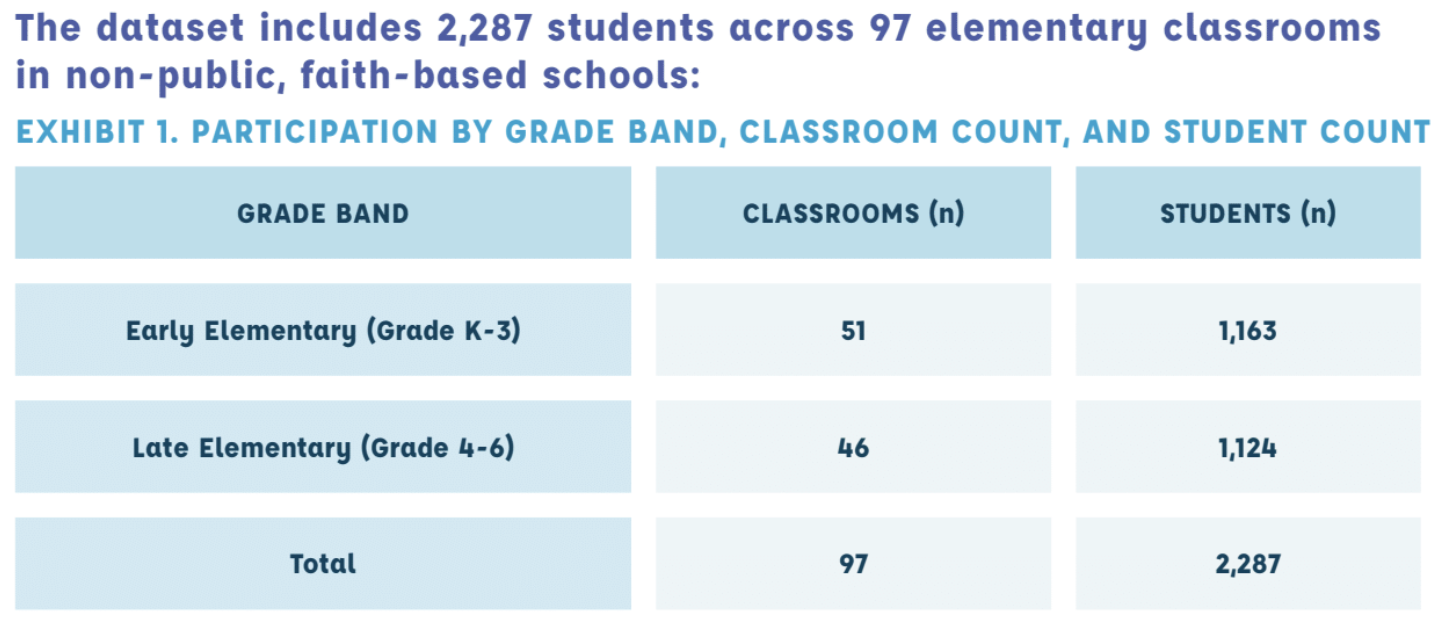 Note: All participating schools implemented the Friendzy Character Education for Faith model as a Tier 1, schoolwide framework during the study period. Student outcomes were assessed using SELweb, a validated, performance-based, norm-referenced assessment of emotional competencies.
The study employed a quantitative longitudinal design examining cumulative growth across three years of sustained implementation.
Analyses included:
Repeated-measures linear modeling (estimated marginal means).
One-way ANOVA comparisons.
Tukey HSD post hoc testing.
Extended-interval comparisons across multi-year exposure.
Emotion Recognition: identifying and interpreting emotional expressions.
Self-Control: impulse management, attentional regulation, and goal-directed behavior.
Social Perspective-Taking: understanding others’ thoughts, feelings, and viewpoints.
Social Problem-Solving: generating constructive responses to interpersonal challenges.
Composite Emotional Competency Score.
All competencies demonstrated consistent upward movement from Year 1 Pretest through Year 3 Posttest. Competencies demonstrated statistically significant growth with the strongest effects (p < .001) emerging in Years 2-3, indicating compounding returns on sustained implementation.
There were:
No plateauing
No regression
No transient effects
Growth strengthened across extended intervals.
The most pronounced incremental lift occurred between Year 2 and Year 3 across multiple domains.
This indicates:
Reinforcement of skills.
Consolidation of skills.
Internalization of skills over time.
The data indicate that emotional competencies deepen with sustained exposure rather than stabilizing after initial adoption. The cumulative nature of this growth is most clearly visualized in Exhibit 2, which illustrates total longitudinal lift across competencies from initial baseline through Year 3 Posttest.
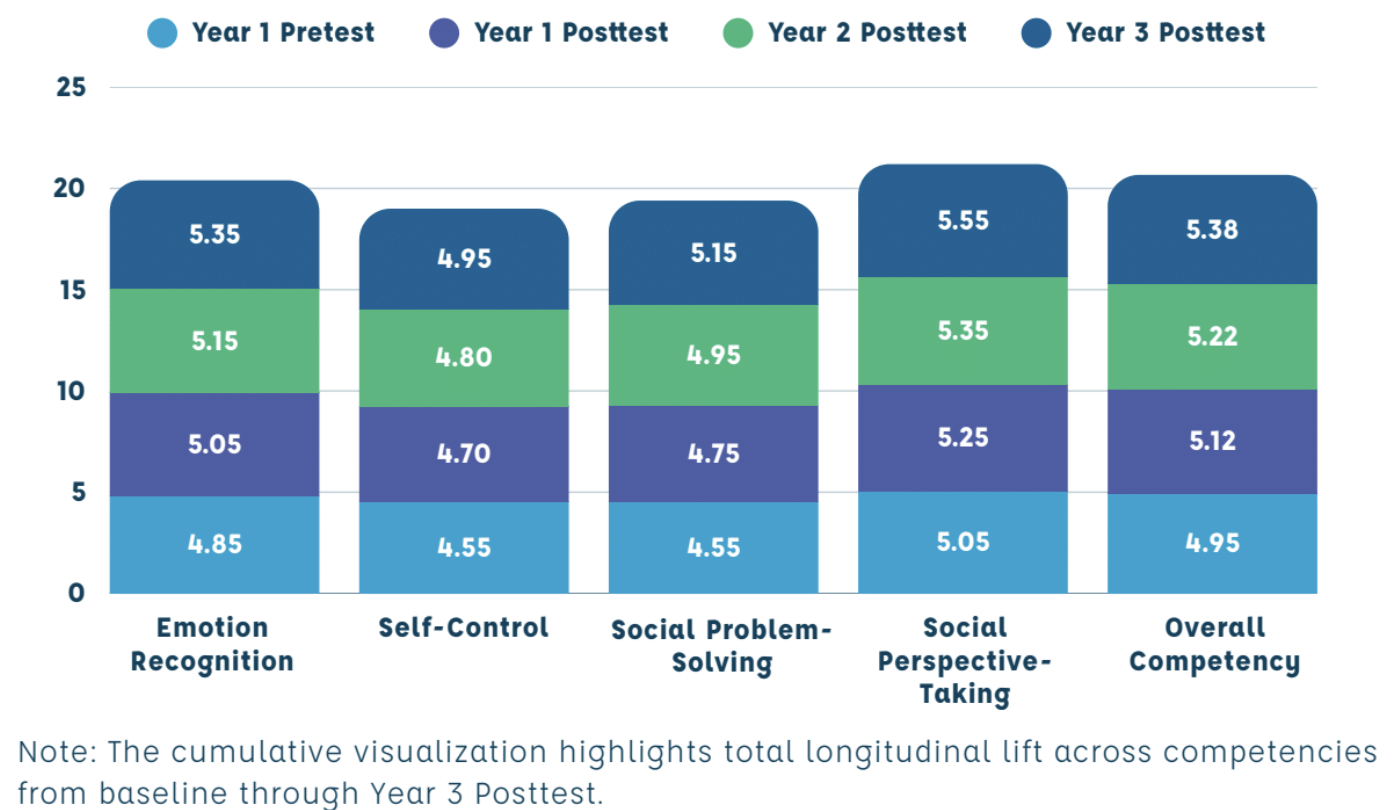
Self-Control began at the lowest baseline level, developmentally consistent with executive function maturation in middle childhood.
Over three years:
Self-Control demonstrated steady and meaningful strengthening.
Gains were strongest across extended multi-year intervals.
This pattern aligns with developmental neuroscience, indicating that self-regulation consolidates through repeated practice and environmental reinforcement.
Participating classrooms began at relatively strong baseline levels. In high-performing environments:
Maintaining and incrementally strengthening high performance represents substantive growth.
Composite emotional competency scores increased significantly across three years.
This suggests Friendzy functions not merely as an intervention tool, but as a reinforcement framework.
For school and system-level leaders, the findings suggest:
Emotional competency development is cumulative, not episodic.
Multi-year implementation yields stronger outcomes than short-term pilots.
Faith-integrated framing can support measurable growth without compromising mission.
Sustained implementation strengthens both relational and executive function competencies.
Measurable gains are evident in Year 1; continued exposure reinforces and compounds growth across competencies.
Ensure educator training integrates faith framing with competency instruction.
Leverage Tier 1 implementation to create environmental consistency across classrooms.
Use norm-referenced assessment data to track reinforcement and identify areas in need of targeted support.
This longitudinal analysis provides evidence that Friendzy Character Education for Faith supports sustained and cumulative development in emotional competencies central to both educational success and spiritual formation.
Across three consecutive years:
Emotion Recognition strengthened steadily.
Social Perspective-Taking reinforced and deepened.
Self-Control consolidated in developmentally coherent patterns.
Composite emotional competency scores increased significantly.
The strongest incremental gains emerged in Year 3, reflecting compounding growth.
These findings suggest that Friendzy functions not as a short-term intervention, but as a formation framework. Sustained implementation supports internalization of emotional competencies.
For school and system-level leaders evaluating multi-year adoption, the evidence indicates that consistent implementation strengthens relational competencies over time and reinforces high-performing developmental benchmarks. In this respect, Friendzy offers a structured, faith-integrated approach to whole-child formation grounded in longitudinal data.