Friendzy's faith-based character education program has measurably improved students' self-control, emotional recognition, and relationship skills across Catholic schools—fostering more peaceful classrooms and emotionally resilient learners.
Catholic education plays a vital role in forming students who excel academically, live out their faith, and lead with compassion and moral conviction. Rooted in the teachings of Christ, Catholic schools emphasize the development of the whole child—mind, body, and spirit. Within this context, character education emerges as an essential component of student formation, helping young learners understand how their feelings, thoughts, and actions work together to shape their character (Peterson, 2020).
Over the past three years, Catholic schools using Friendzy have seen this transformation firsthand. Friendzy is a whole-school, faith-based character education program that weaves together Scripture, supporting Catholic character development—offering a formation experience that aligns beautifully with the mission and heart of Catholic education.

Through Scripture-centered lessons, shared daily language, and engaging activities, Friendzy equips students to build strong relationships, practice self-control, and grow in both emotional and spiritual maturity. It helps Catholic educators fulfill their sacred mission: to form students who reflect Christ in how they live, learn, and love.
Catholic schools are committed to nurturing students in both faith and character, but educators have faced increasing challenges in supporting students’ social, emotional, and moral development. Teachers and administrators reported a rise in behavioral issues, peer conflicts, and emotional struggles that disrupted learning and strained school communities. Many schools lacked structured resources to help students develop resilience, empathy, and self-control in a way that aligned with Catholic values. Recognizing the need for a faith-based approach to character education, schools sought a solution that would reinforce scripture while equipping students with essential life skills. This need led them to implement Friendzy, a Biblically-based program designed to integrate character education with Catholic identity, fostering a culture of belonging, empathy, and strong moral character.

— 3rd Grade Teacher
From 2022 to 2024, Friendzy partnered with Catholic schools to provide a faith-based, evidence-driven framework for developing essential social, emotional, and moral virtues. Recognizing the need for a program that aligns with Catholic teachings while addressing behavioral and emotional challenges, Friendzy’s framework integrates character education with scripture to cultivate resilience, empathy, and self-control.
Using Insights Assessment (McKown, 2017), Friendzy measured growth in key areas such as self-control, emotional recognition, and overall moral development—reinforcing the Catholic mission of educating the whole child. This biannual assessment provided norm-referenced scores and percentile rankings, equipping educators with a clear roadmap for fostering both emotional intelligence and virtuous leadership in their students.
Students showed a steady, year-over-year improvement in students’ social-emotional character skills. Individuals scoring at or above average increased by +2.43% in 2022–2023 and rose even higher—by +9.13%—in 2023–2024. Meanwhile, below-average scores dropped significantly (-4.51% in Year One and -8.28% in Year Two). Through Friendzy’s character development program, more students aren’t simply improving—they’re thriving.
Growth in students at or above average:
+2.43% 2022-2023
+9.13% 2023-2024
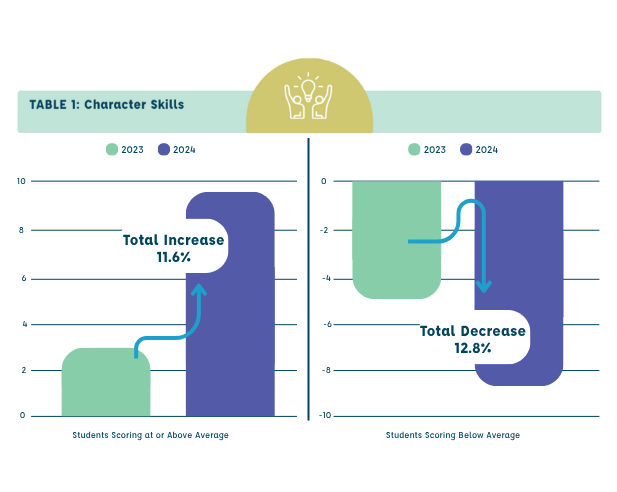
Drop in Students scoring below average:
-4.51% 2022-2023
-8.28% 2023-2024
What we’ve observed isn’t just a shift in numbers—it’s a shift in culture. Hallways are calmer, classrooms are more joyful, and students are using their words, managing emotions, and caring for one another.
“Students are doing better at working through problems and referring back to what we learned in Friendzy.”
—1st Grade Teacher
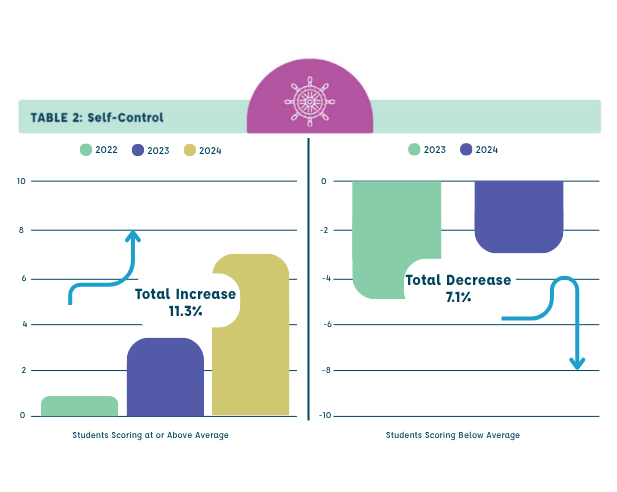
Self-control, a critical virtue in Catholic teachings on discipline and moral decision-making, saw significant improvement through Friendzy’s program:
Students with above-average self-control scores increased steadily:
+0.7% in 2022
+3.79% in 2023
+6.82% in 2024
Students with below-average self-control scores decreased:
-4.51% in 2022-2023
-2.56% in 2023-2024
Teachers observed that students were better able to regulate their emotions and make thoughtful decisions. Self-control is foundational to both academic success and faith formation. In Catholic education, self-discipline is deeply connected to moral decision-making and spiritual growth. The ability to pause, reflect, and choose the right course of action—whether in academics, relationships, or personal challenges—aligns with teachings on patience, forgiveness, and responsibility (Catechism of the Catholic Church, 1804). Research shows that self-regulation skills directly impact student achievement, classroom behavior, and emotional resilience (Duckworth & Seligman, 2005). Friendzy teaches skills to equip students; for instance, students practiced taking deep breaths to calm themselves before reacting, or they chose forgiveness over retaliation when conflicts arose. One teacher shared, “The lessons have equipped my students with tools to manage their emotions and handle challenges with grace.”
Emotional recognition, the ability to identify and understand one’s own emotions, is foundational to building empathy and compassion—key virtues in Catholic character education. Friendzy’s impact in this area was significant. By 2024, nearly 1 in 4 more students met emotional recognition expectations compared to 2022. This suggests that students are better able to process their emotions, express feelings appropriately, and apply emotional intelligence in daily interactions. Research indicates empathy is crucial in classrooms today, fostering a positive learning environment and promoting social connection (Swan & Riley, 2015; Franzese, 2017).
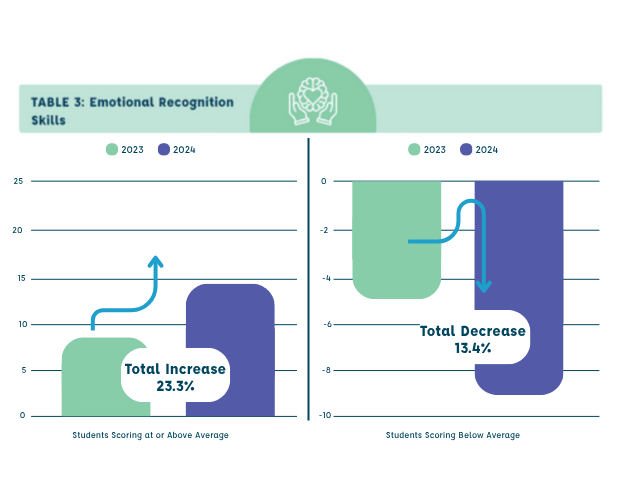
Students meeting emotional recognition expectations increased:
+8.33% in 2022-2023
+14.99% in 2023-2024
Students with below-average emotional recognition scores decreased:
-4.51% in 2022-2023
-8.89% in 2023-2024
These improvements enabled students to better understand their feelings and respond in ways consistent with their faith. The 13.4% overall reduction in below-average emotional recognition scores indicates that fewer students experience confusion, frustration, or difficulty managing emotions, leading to a more emotionally stable learning environment. Emotional recognition is foundational to developing empathy and compassion, central to Catholic teachings on loving one’s neighbor (Luke 10:27). As students grow in emotional awareness, they are more likely to respond with kindness, resolve conflicts peacefully, and support their peers. And the impact doesn’t stop there. Hattie (2009) found that students who feel emotionally connected to their learning are more motivated, retain more, and achieve more.
A principal noted, “I’ve seen students who once struggled with frustration now approach challenges with patience and understanding. It’s a testament to how Friendzy helps us fulfill our Catholic mission to form character.”

— School Counselor
Friendzy’s character education program is a powerful ally in Catholic schools’ mission to nurture the whole child—mind, heart, and spirit. Rooted in biblical truth and aligned with Catholic values, Friendzy integrates faith formation with social and emotional growth, equipping students to thrive academically while living out their faith with compassion and purpose.
This impact report highlights meaningful outcomes across Catholic schools: students are demonstrating greater self-control, resolving conflicts with empathy and forgiveness, and building stronger, more collaborative relationships in the classroom. These positive changes reflect not only the strength of Friendzy’s curriculum but also the deep dedication of Catholic educators who weave faith, virtue, and care into every aspect of school life.
The character education taught through Friendzy has resulted in noticeable improvements in student behavior across Catholic schools:
Fewer classroom disruptions as students practiced self-regulation strategies learned through Friendzy
Decreased peer conflicts as students used tools like active listening and seeking forgiveness
Increased collaboration and kindness in group activities, as students encouraged and supported one another
As one school administrator shared, “Friendzy doesn’t just teach character—it weaves Catholic values into every lesson, creating a culture of empathy, respect, and kindness.”
While no single program stands alone, Friendzy complements the rich spiritual and academic environment already present in Catholic education. In today’s complex world, Friendzy offers a faithful, practical framework for helping students live out the Gospel daily—building skills for good, skills for life.
Citations
Duckworth, A. L., & Seligman, M. E. P. (2005). Self-discipline outdoes IQ in predicting academic performance of adolescents. Psychological Science, 16(12), 939–944.
Hattie, J. (2009). Visible learning: A synthesis of over 800 meta-analyses relating to achievement. Routledge.
McKown, C. (2017). Social-emotional assessment, performance, and standards. In S. M. Jones, E. Doolittle, & S. McLanahan (Eds.), The future of children: Special issue on social-emotional learning (pp. 157–178). Princeton University Woodrow Wilson School of Public and International Affairs and the Brookings Institution. https://doi.org/10.1353/foc.2017.0008
Peterson, C. (2020). Character strengths and virtues: A handbook and classification. American Psychological Association.=
Swan, P., & Riley, P. (2015). Social connection: Empathy and mentalization for teachers. Pastoral Care in Education, 33(4), 220–233. https://doi.org/10.1080/02643944.2015.1094120