This report highlights the measurable success of Friendzy’s Character Development for Faith program in Christian schools post-COVID, showing notable gains in self-control, empathy, emotional recognition, and school culture among K–3rd grade students from 2022 to 2024.
This report explores Christian schools' unique challenges Christian schools dace post-COVID and the meaningful and measurable impact of implementing Friendzy Character Development for faith programming. The highlighted data underscores the efficacy of the Friendzy program, specifically with K-3rd-grade students across a diverse range of Christian schools within the U.S. These measured findings span over three school years, from 2022 to 2024.
Notable findings include consistent growth in character development skills, fewer classroom disruptions through increased self-control skills, observed gains in empathy, increased emotional recognition, and substantial cultural and spiritual impacts across school campuses.
Since 2020, teachers have consistently reported more frequent classroom disruptions, peer conflicts, and emotional distress—all of which have strained learning environments and tested the limits of available support systems. With limited 1:1 and small group resources available through counseling and student service supports, schools have struggled to find accessible classroom curricula and programming that support the development of foundational character skills essential for bolstering student success academically, socially, and spiritually.
The lack of unified programming and support has led to disjointed and ineffective solutions, increased teacher burnout, increased disrupted learning, and strained school communities with weakened parent and teacher relationships. Recognizing the need for a faith-based and comprehensive approach to character education, schools sought a campus-wide solution to support teachers and families, and most importantly, equip students with essential life skills.
What posed the greatest challenge for many schools was finding programming that provided high-quality and effective character development while also integrating seamlessly with their Christian mission and spiritual formation goals. This need led many schools to implement Friendzy, a Biblically-based program designed to weave character education with Christian identity, fostering a culture of belonging, empathy, and strong moral character.

Friendzy was created to meet these challenges head-on. Through Scripture-centered lessons, daily language, and engaging activities, Friendzy equips schools to foster stronger relationships, build self-control, and cultivate emotional and spiritual maturity in every student.
Over a three-year partnership (2022–2024), Christian schools implemented Friendzy’s comprehensive character development framework. Through interactive lessons, shared school-wide language, and daily application of Biblical principles, students measurably increased their development of key life skills—self-control, empathy, resilience, conflict resolution, and more.
Educators didn't just see smoother classrooms. They saw hearts changing. Using Insights Assessments (McKown, 2017), Friendzy measured growth in key areas such as self-control, emotional recognition, and social perspective taking. This biannual assessment provided norm-referenced scores and percentile rankings that allow educators to see how their students are developing socially and emotionally compared to national benchmarks. The assessment gives schools clear, actionable insights to guide instruction, monitor progress, and strengthen their efforts to support whole-child development rooted in Scripture.

— 3rd Grade Teacher
From 2022 to 2024, Friendzy partnered with Christian schools to provide a faith-based, evidence-driven framework for developing essential social, emotional, and moral virtues. Recognizing the need for a program that aligns with Christian teachings while addressing behavioral and emotional challenges, Friendzy’s framework integrates character education with scripture to cultivate resilience, empathy, and self-control.
Using Insights Assessment (McKown, 2017), Friendzy measured growth in key areas such as self-control, emotional recognition, and overall moral development—reinforcing the Christian mission of educating the whole child. This biannual assessment provided norm-referenced scores and percentile rankings, equipping educators with a clear roadmap for fostering both character-building skills and virtuous leadership in their students.
Students showed a steady, year-over-year improvement in students’ character-building skills. Individuals scoring at or above average increased by +2.43% in 2022–2023 and rose even higher, by +9.13%, in 2023–2024. Meanwhile, below-average scores dropped significantly (-4.51% in Year One and -8.28% in Year Two). Through Friendzy’s character development program, more students aren’t simply improving—they’re thriving.
Growth in students at or above average:
+2.43% 2022-2023
+9.13% 2023-2024
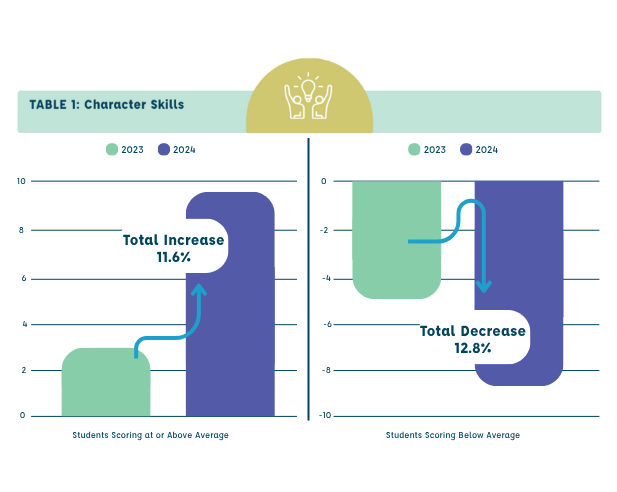
Drop in Students scoring below average:
-4.51% 2022-2023
-8.28% 2023-2024
Teachers and administrators also reported observing dramatic positive changes in school culture. Hallways were reported to feel calmer, classrooms more joyful, and students were frequently found using advanced communication skills in dealing with conflict, managing their emotions, and caring for one another.
“Students are doing better at working through problems and referring back to what we learned in Friendzy.” —1st Grade Teacher
One of the most inspiring areas of growth revealed in this study is self-control—an essential fruit of the Spirit and a cornerstone of character. James 1:19 reminds us to be "quick to listen, slow to speak and slow to become angry," and when schools teach these life skills, transformation follows.
Between 2022 and 2024, students demonstrating above-average self-control grew significantly—from just +0.7% in 2022 to +6.82% by 2024. At the same time, those scoring below average dropped by 4.51% in the first year and 2.56% in the second.
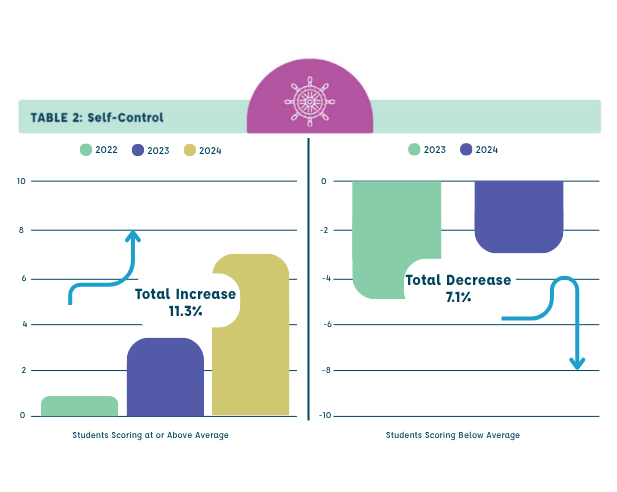
Students with above-average self-control scores increased steadily:
+0.7% in 2022
+3.79% in 2023
+6.82% in 2024
Students with below-average self-control scores decreased:
-4.51% in 2022-2023
-2.56% in 2023-2024
This growth didn’t just show up in the data—it came to life in the classroom. Teachers reported their awe in seeing students pausing in moments of frustration, breathing through conflict, choosing kindness over retaliation, and taking ownership of their actions.
“The lessons have equipped my students with tools to manage their emotions and handle challenges with grace.” — Kindergarten Teacher
For Christian schools implementing the Friendzy for Faith program, this isn’t just character development—it’s spiritual formation in action. As Duckworth and Seligman (2005) affirmed, self-regulation is a powerful predictor of academic and life success. When students are allowed to intentionally develop character skills and tie those skills directly back to scripture, they are far more likely to walk through life clothed in the fruit of the Spirit, contribute positively to their community, and experience the blessings of an authentically faith-filled life.
Research confirms that to develop empathy, students must see it taught, modeled and have the opportunity to practice. Friendzy lessons help students understand their own feelings, which builds compassion for others. When students learn to recognize and name their emotions, they begin to act with empathy, patience, and kindness—core characteristics of Christ-like love (Luke 10:27).
In the Friendzy study, emotional recognition scores rose by 8.33% in 2022–2023 and by an impressive 14.99% in 2023–2024. The number of students struggling in this area decreased by 13.4% over the same period.
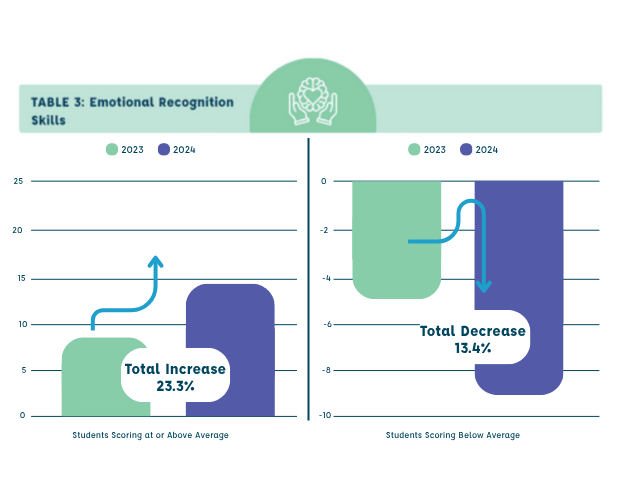
Emotional recognition scores increased:
+8.33% in 2022-2023
+14.99% in 2023-2024
Below-average scores dropped:
-4.51% in 2022-2023
-8.89% in 2023-2024
This kind of growth builds stronger classrooms and a deeper community. Research indicates empathy is crucial in classrooms today, fostering a positive learning environment and promoting social connection (Swan & Riley, 2015; Franzese, 2017).
“I’ve seen students who once struggled with frustration now approach challenges with patience and understanding. It’s a testament to how Friendzy helps us fulfill our mission to form character.” — Principal, Christian School Leader
And the impact doesn’t stop there. Hattie (2009) found that students who feel emotionally connected to their learning are more motivated, retain more, and achieve more.

— School Counselor
Friendzy is more than a curriculum—it’s a Christ-centered framework that empowers students to live out their faith every day. Through daily habits of compassion, active listening, self-control, and spiritual growth, students are equipped to reflect Christ in both their relationships and choices.
Christian schools using Friendzy report:
Fewer classroom disruptions as students apply self-regulation tools
Decreased peer conflict as students embrace forgiveness and empathy
Increased collaboration and kindness as students support one another
Friendzy strengthens what Christian schools do best: forming students who know God and love their neighbors. By integrating faith with character skills, Friendzy supports educators in nurturing the whole child—mind, heart, and spirit.
“Friendzy doesn’t just teach character—it weaves Christian values into every lesson, creating a culture of empathy, respect, and kindness.”
— School Administrator
Still, we recognize that the transformation happening in these schools is not solely because of one program. It is the result of deeply committed educators, prayerful communities, and the holistic support structures that Christian schools provide. Friendzy’s impact is a reflection of your faithfulness.
Together, we are forming a generation of compassionate, resilient, and faith-filled students who live with integrity, walk in love, and reflect the heart of Christ in an ever-changing world.
Friendzy: Building skills for good. Skills for life. Rooted in Christ.
Citations
Duckworth, A. L., & Seligman, M. E. P. (2005). Self-discipline outdoes IQ in predicting academic performance of adolescents. Psychological Science, 16(12), 939–944.
Hattie, J. (2009). Visible learning: A synthesis of over 800 meta-analyses relating to achievement. Routledge.
McKown, C. (2017). Social-emotional assessment, performance, and standards. In S. M. Jones, E. Doolittle, & S. McLanahan (Eds.), The future of children: Special issue on social-emotional learning (pp. 157–178). Princeton University Woodrow Wilson School of Public and International Affairs and the Brookings Institution. https://doi.org/10.1353/foc.2017.0008
Peterson, C. (2020). Character strengths and virtues: A handbook and classification. American Psychological Association.=
Swan, P., & Riley, P. (2015). Social connection: Empathy and mentalization for teachers. Pastoral Care in Education, 33(4), 220–233. https://doi.org/10.1080/02643944.2015.1094120