A simple, brain-based tool to help your middle schoolers manage stress and get ready to learn: in 90 seconds flat.
Anxiety. Social pressure. Digital overload. And it's showing up in your classroom every day—emotional reactivity, foggy focus, disengagement.
They're not choosing to check out. Most of them just don't have the tools yet.
This gives them one.
When you download, you'll get:
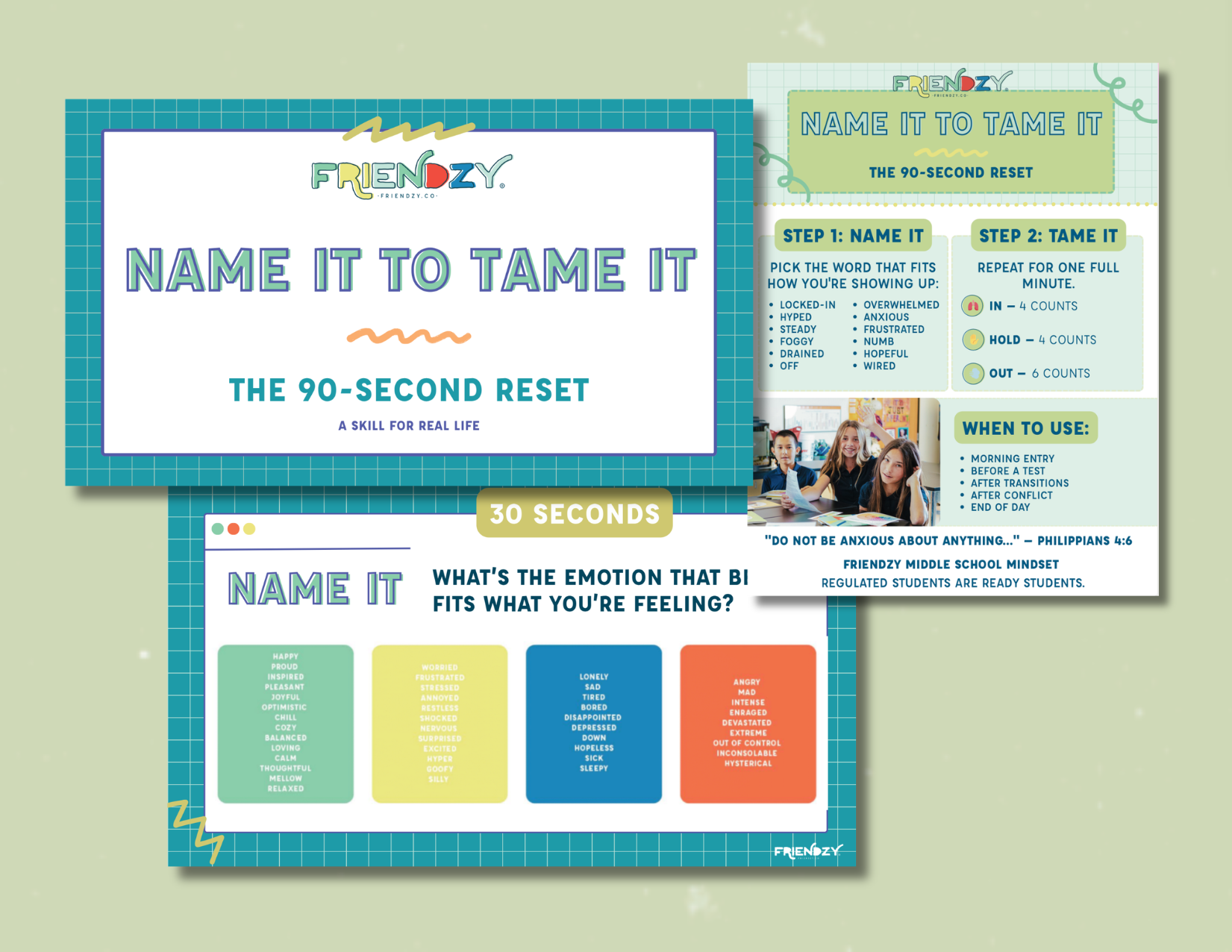
✓ A 10-slide student-facing slide deck — ready to teach Monday morning.
✓ The Friendzy Daily Check-In Tool built into the lesson.
✓ Teacher speaker notes for every slide.
✓ Brain science + faith integration (Philippians 4:6).
✓ Live practice activity — guided box breathing.
Built specifically for 5th–8th grade classrooms.
Step 1: Name It (30 sec). Students use the Friendzy Daily Check-In Tool to pick the word that fits how they're showing up.
Step 2: Tame It (60 sec). Students practice box breathing — in for 4, hold for 4, out for 6, hold for 4. Repeat for one minute.
That's it. No fluff. No production. Just a tool your students can use Monday morning.
This isn't another wellness trend. It's grounded in 20+ years of neuroscience and trusted by educators, athletes, first responders, and Navy SEALs who use these exact techniques in the highest-pressure moments of their lives.
Two things neuroscientists know:
Naming a feeling calms the brain. Labeling an emotion activates the prefrontal cortex and quiets the amygdala.¹
Strong emotions pass in about 90-seconds. If we don't keep feeding them, they move through the body fast.²
Put those two things together and you have a portable, research-backed tool any middle schooler can learn — and any teacher can lead.
Every step is anchored in Scripture. Students learn that God designed their brains and bodies with a built-in reset — and that naming what's heavy is the first step toward handing it to Him.
"Do not be anxious about anything…" — Philippians 4:6.
"It's helping our class grow into a family. The Daily Check-in Tool, Warm Welcomes are working well for us."
— Kelsey B. | 8th Grade Teacher, St. Columba School
The Brain Science: Why naming feelings calms the brain
The 90-Second Rule: How emotions actually move through the body
Your Breath = Your Reset Button: Who uses this skill (athletes, Navy SEALs, surgeons)
Step 1: Name It: Using the Daily Check-In Tool
Step 2: Tame It: Box breathing live practice
Faith Anchor: Philippians 4:6 close
Designed for one class period. Adaptable for advisory, homeroom, or morning meeting.
We'll never spam you. Unsubscribe anytime.
The 90-Second Reset is a small piece of Friendzy's Middle School Mindset — a full PD experience that equips your educators and transforms your middle school culture.
¹ Lieberman, M. D., Eisenberger, N. I., Crockett, M. J., Tom, S. M., Pfeifer, J. H., & Way, B. M. (2007). Putting feelings into words: Affect labeling disrupts amygdala activity in response to affective stimuli. Psychological Science, 18(5), 421–428. See also: Siegel, D. J. (2012). The Developing Mind: How Relationships and the Brain Interact to Shape Who We Are (2nd ed.). Guilford Press.
² Taylor, J. B. (2008). My Stroke of Insight: A Brain Scientist's Personal Journey. Viking Penguin. See also: Taylor, J. B. (2021). Whole Brain Living: The Anatomy of Choice and the Four Characters That Drive Our Life. Hay House.
³ Ma, X., Yue, Z. Q., Gong, Z. Q., Zhang, H., Duan, N. Y., Shi, Y. T., Wei, G. X., & Li, Y. F. (2017). The effect of diaphragmatic breathing on attention, negative affect and stress in healthy adults. Frontiers in Psychology, 8, 874. (Supports the use of slow, extended-exhale breathing for stress regulation.)
⁴ Zaccaro, A., Piarulli, A., Laurino, M., Garbella, E., Menicucci, D., Neri, B., & Gemignani, A. (2018). How breath-control can change your life: A systematic review on psycho-physiological correlates of slow breathing. Frontiers in Human Neuroscience, 12, 353.
⁵ Immordino-Yang, M. H., & Damasio, A. (2007). We feel, therefore we learn: The relevance of affective and social neuroscience to education. Mind, Brain, and Education, 1(1), 3–10.