The Ten Commandments, once seen as restrictive, are reframed through Jesus’ teaching as a call to love—guiding emotional, relational, and spiritual growth in Catholic classrooms.
By: Jim King | Saints & Scholars Consulting
Growing up, part of my biggest memories of the Ten Commandments was largely created through the movie images of Charlton Heston’s wild hair and bushy beard. My mind’s eye goes to scenes of terrible plagues, pillars of fire, and a Hollywood booming voice of God pronouncing a series of threatening “Thou shall not’s.” They were very ominous depictions of a dangerous and wrathful God that generated emotions of not only dread and fear but shame. The Commandments always left me with feelings of an unhealthy shame - what a terrible disappointment I must be to God. So frankly, the Ten Commandments and emotional health are not two concepts I would have pinned together. Yet, as I’ve grown in faith and understanding, it’s interesting how God’s truth gets revealed.
The Father saw how literal we all were in comprehending His gift of the Ten Commandments (and more) and used the teachings of His Son to open our eyes. In the Gospels, Jesus shows us how we are to live. Subsequently, Jesus explains how our lives should demonstrate the deeper call of Ten Commandments for us to love both God and one another.
When asked which Commandment in the Law is the greatest, Jesus responded with a clarification of the entire Ten Commandments:
“You shall love the Lord your God with all your heart, and with all your soul, and with all your mind. […] And a second is like it: You shall love your neighbor as yourself. On these two commandments hang all the Law and the prophets.” (Matthew 22:37–40)
This Great Command, as we know it, is not a reduction of the Commandments, but an amplification of what it truly means to follow them with intentionality. This intentionality is where we see Jesus uncovering the full meaning of what God intended for us through the Ten Commandments. We are familiar with the story of the good man who comes to Jesus.
“A man ran up to (Jesus) and fell on his knees before him. ‘Good teacher,’ he asked, ‘what must I do to inherit eternal life?’ … Jesus answered. ‘… You know the commandments: ‘You shall not murder, you shall not commit adultery, you shall not steal...’ ‘Teacher,’ he declared, ‘all these I have kept since I was a boy’ ” (Mark 10: 17-20.)
Jesus spots that the man has lived the overt interpretation of the Commandments. Jesus calls him to follow the Commandments through “love.” This love for his neighbors is a deeper and harder way than the literal interpretation. Not killing, stealing from, or lying about one’s neighbor can be less demanding than taking action to love them. Jesus points out how to the man how to better love his neighbor and the man is instantly overtaken with the realization of the deeper meaning.
Jesus looked at him and loved him. ‘One thing you lack,’ he said. ‘Go, sell everything you have and give to the poor, and you will have treasure in heaven. Then come, follow me.’ At this the man’s face fell. He went away sad, because he had great wealth” (Mark 10: 21-22.)
An interesting Examination of Conscience offers a phrasing of the Ten Commandments that aligns beautifully with the Great Commandment. This reframing considers “do’s” instead of ‘do not’s”
1. We honor God as Creator. We praise him and would never put anything else in His place in our lives.
2. We always show reverence and honor to God, so would never use his name in a disrespectful way.
3. We remember to worship God by participating at Sunday mass, and through that we give honor to ourselves, as well, by resting, praying, and doing good deeds for others.
4. We respect our parents and their authority. We also give that same respect to those who are given authority over us as long as they protect and care for our good.
5. We respect life as being sacred in all its forms which has dignity and beauty.
6. We respect the family and our part in family life. We respect marriage as being the place for sexual relationship. We respect our own bodies and those of others.
7. We respect the property of others.
8. We respect others by being honest and truthful. We do not gossip or try to harm others’ reputations.
9. We respect our relationships and the relationships of other people.
10. We are satisfied with and are grateful for the gifts which we have been given.
Love is not simply an ideal - it’s an action. In Catholic classrooms, the Great Commandment becomes tangible when students are equipped with the tools to live it out in daily relationships. Social-emotional wellness isn’t separate from spiritual formation - it is a vital expression of it.
Modern research supports what Catholic tradition has long understood: students who struggle with emotional regulation are more likely to experience conflict, disconnection, and isolation. Without the tools to understand and manage their emotions, students may act in ways that harm relationships or violate their values and leads us into a life apart from God: sin.
Conversely, students who develop emotional literacy—who know how to name their feelings, pause before reacting, and listen to others—are far more likely to live virtuous lives. They become peacemakers. They speak truth in love. They make choices from a well-formed conscience rather than raw emotion.
Here are practical ways Catholic educators can help students grow in relationship skills aligned with the Commandments:
Start the day by focusing on one commandment and inviting students to reflect on how it relates to their relationships with God and others.
Use real-life scenarios to help students practice peacemaking, honesty, and empathy—then connect those behaviors to specific commandments.
Teach students to name their emotions and reflect on how those feelings may influence their actions. This builds empathy and moral awareness.
When a student breaks a rule, guide them to reflect not just on what they did wrong, but whom they may have hurt—and how to make it right.
When students learn that love means acting in ways that protect and restore relationships, the Commandments become more than theology—they become tools for holy living.
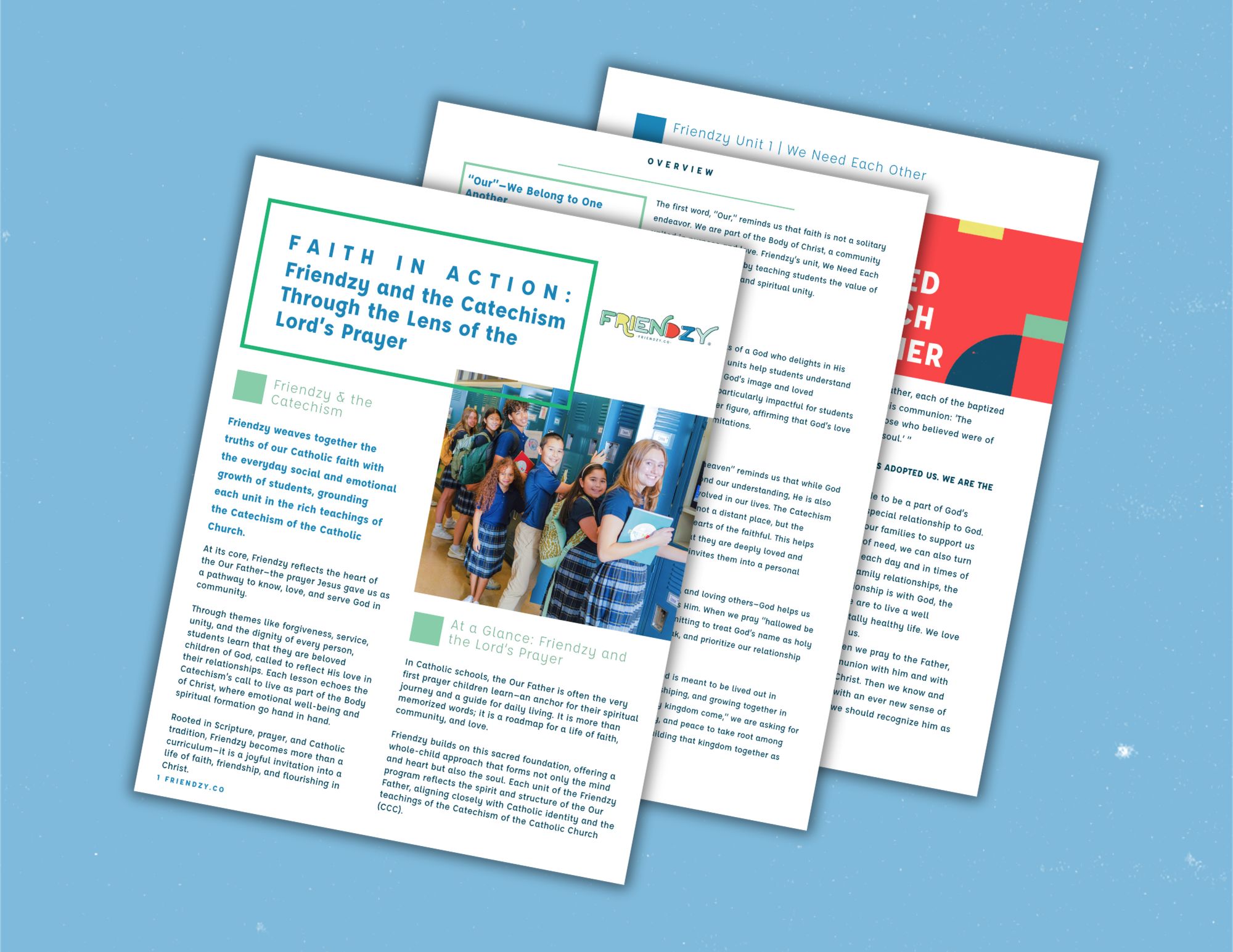
Bring the Ten Commandments to Life School Wide
If this vision resonates, discover how Friendzy’s Scripturally based social emotional character education program can help your entire school form students in faith, character, and relationships.
Explore the Ten Commandments Crosswalk
See how each Commandment aligns with Catholic teaching and supports social, emotional, and character formation in students.
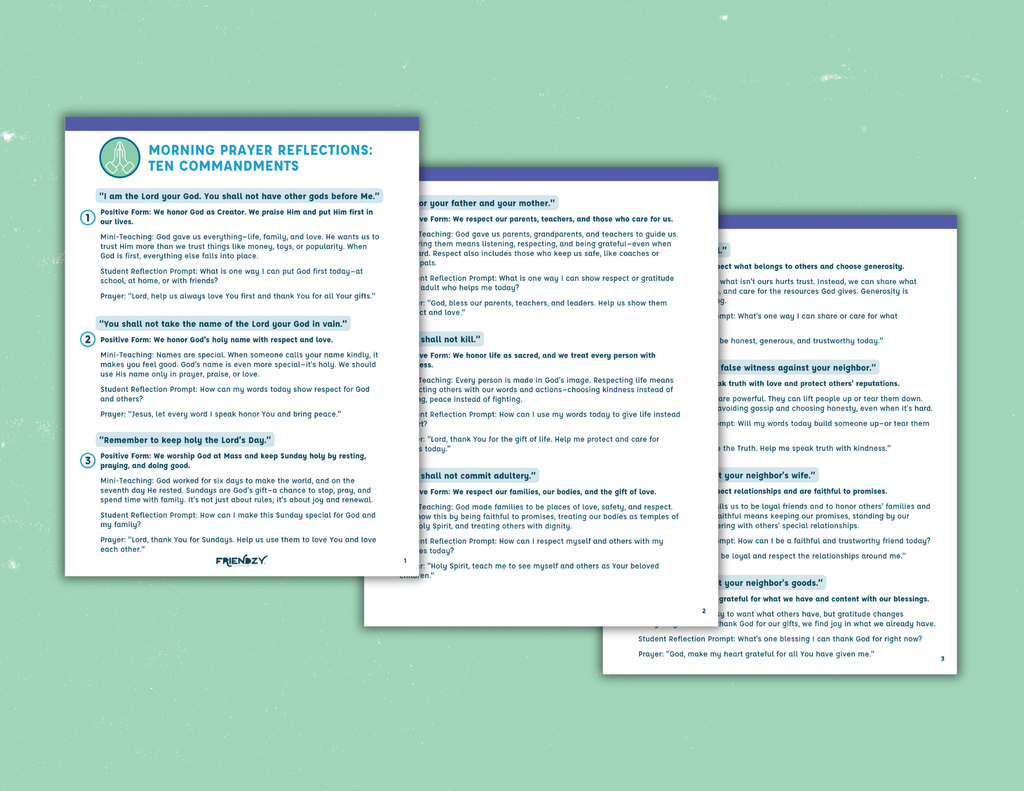
Start the day by focusing on one commandment and inviting students to reflect on how it relates to their relationships with God and others.
1. “I am the Lord your God. You shall not have other gods before Me.”
➡️ Positive Form: We honor God as Creator. We praise Him and put Him first in our lives.
Mini-Teaching: God gave us everything—life, family, and love. He wants us to trust Him more than we trust things like money, toys, or popularity. When God is first, everything else falls into place.
Student Reflection Prompt: What is one way I can put God first today—at school, at home, or with friends?
Prayer: “Lord, help us always love You first and thank You for all Your gifts.”
2. “You shall not take the name of the Lord your God in vain.”
➡️ Positive Form: We honor God’s holy name with respect and love.
Mini-Teaching: Names are special. When someone calls your name kindly, it makes you feel good. God’s name is even more special—it’s holy. We should use His name only in prayer, praise, or love.
Student Reflection Prompt: How can my words today show respect for God and others?
Prayer: “Jesus, let every word I speak honor You and bring peace.”
3. “Remember to keep holy the Lord’s Day.”
➡️ Positive Form: We worship God at Mass and keep Sunday holy by resting, praying, and doing good.
Mini-Teaching: God worked for six days to make the world, and on the seventh day He rested. Sundays are God’s gift—a chance to stop, pray, and spend time with family. It’s not just about rules; it’s about joy and renewal.
Student Reflection Prompt: How can I make this Sunday special for God and my family?
Prayer: “Lord, thank You for Sundays. Help us use them to love You and love each other.”
4. “Honor your father and your mother.”
➡️ Positive Form: We respect our parents, teachers, and those who care for us.
Mini-Teaching: God gave us parents, grandparents, and teachers to guide us. Honoring them means listening, respecting, and being grateful—even when it’s hard. Respect also includes those who keep us safe, like coaches or principals.
Student Reflection Prompt: What is one way I can show respect or gratitude to an adult who helps me today?
Prayer: “God, bless our parents, teachers, and leaders. Help us show them respect and love.”
5. “You shall not kill.”
➡️ Positive Form: We honor life as sacred, and we treat every person with kindness.
Mini-Teaching: Every person is made in God’s image. Respecting life means protecting others with our words and actions—choosing kindness instead of hurting, peace instead of fighting.
Student Reflection Prompt: How can I use my words today to give life instead of hurt?
Prayer: “Lord, thank You for the gift of life. Help me protect and care for others today.”
6. “You shall not commit adultery.”
➡️ Positive Form: We respect our families, our bodies, and the gift of love.
Mini-Teaching: God made families to be places of love, safety, and respect. We show this by being faithful to promises, treating our bodies as temples of the Holy Spirit, and treating others with dignity.
Student Reflection Prompt: How can I respect myself and others with my choices today?
Prayer: “Holy Spirit, teach me to see myself and others as Your beloved children.”
7. “You shall not steal.”
➡️ Positive Form: We respect what belongs to others and choose generosity.
Mini-Teaching: Taking what isn’t ours hurts trust. Instead, we can share what we have, return things, and care for the resources God gives. Generosity is the opposite of stealing.
Student Reflection Prompt: What’s one way I can share or care for what belongs to others?
Prayer: “God, help me be honest, generous, and trustworthy today.”
8. “You shall not bear false witness against your neighbor.”
➡️ Positive Form: We speak truth with love and protect others’ reputations.
Mini-Teaching: Words are powerful. They can lift people up or tear them down. Being truthful means avoiding gossip and choosing honesty, even when it’s hard.
Student Reflection Prompt: Will my words today build someone up—or tear them down?
Prayer: “Jesus, You are the Truth. Help me speak truth with kindness.”
9. “You shall not covet your neighbor’s wife.”
➡️ Positive Form: We respect relationships and are faithful to promises.
Mini-Teaching: God calls us to be loyal friends and to honor others’ families and commitments. Being faithful means keeping our promises, standing by our friends, and not interfering with others’ special relationships.
Student Reflection Prompt: How can I be a faithful and trustworthy friend today?
Prayer: “Lord, help me be loyal and respect the relationships around me.”
10. “You shall not covet your neighbor’s goods.”
➡️ Positive Form: We are grateful for what we have and content with our blessings.
Mini-Teaching: It’s easy to want what others have, but gratitude changes everything. When we thank God for our gifts, we find joy in what we already have.
Student Reflection Prompt: What’s one blessing I can thank God for right now?
Prayer: “God, make my heart grateful for all You have given me.”

The Friendzy Daily Check-in Tool equips students with grade appropriate vocabulary and visual indicators designed to help students in identifying and naming their emotional state. The Friendzy Daily Check-in Tool is grade-banded and available to download in four convenient sizes:
An 8x11 Handout
A half-page desktop format
A multi-page classroom poster
A digital version slide deck
Use this brief daily exercise to make a big difference in your students’ overall wellbeing. When you talk about emotions every day, you are increasing every student’s emotional literacy and teaching them that emotions are temporary and can vary in intensity. This will lead to greater academic success and coping skills!
Remember, you may not “fix” the emotion, but you can acknowledge it! The Friendzy Daily Check-in Tool will allow you to acknowledge the emotions your students are experiencing and in doing so, will demonstrate care and concern for that student. As the teacher, you can model emotional expression and healthy coping skills! Students need to see adults in their lives identify and acknowledge their own emotions in a way that is healthy and productive. You can do it!
BIO | Jim King - Saints & Scholars Consulting

Dr. Jim King is a seasoned Catholic educator whose career spans from classroom aide to superintendent. He holds both an M.A. and Ph.D. in Catholic educational leadership and has served at national levels with the NCEA and USCCB.
His research focuses on Catholic school leadership and cultivating vibrant Catholic culture in educational communities.
Citations:
Archdiocese of Galveston-Houston. (2012). Positive phrasing of the Ten Commandments. In Sacred and safe: 8th grade handouts (8th grade). Archdiocese of Galveston-Houston. (Original PDF formerly available at https://www.archgh.org/media/4129/sacred-and-safe-8th-grade-handouts.pdf)