May is Mental Health Awareness Month—a time to shine a light on the emotional challenges individuals face and to honor the resilience that carries them through.
By: Julie Widman Ed.D. | Friendzy Co-founder
In schools across the country, educators are witnessing more signs of stress, anxiety, and emotional challenges among students than ever before (Substance Abuse and Mental Health Services Administration, 2023). But within each of these struggles is a story of strength waiting to be seen. As we elevate the importance of mental health this month, we also recognize the critical role educators play in creating environments where students feel safe, supported, known, and loved.
At Friendzy, we believe educators are central to these stories. Every day, teachers show up—not only to instruct, but to guide, nurture, and respond to students carrying emotional loads that often go unseen. At Friendzy, we call the weight and burden students carry their “invisible backpack”. Caring adults can help students unpack the heaviness they bring into school. When educators are equipped with a clear understanding of how stress impacts the brain and behavior, they’re better able to lead with compassion and respond in ways that create safety, stability, and connection.
That’s the heart behind our approach: helping students and educators understand what’s happening inside during times of stress, and offering simple, relational strategies to support emotional growth. Our framework empowers teachers to ask, “What does this student need right now—and how can I respond in a way that supports both learning and well-being?”
Through Friendzy, educators use a simple, three-part approach: Regulate – Respond – Relate. This isn’t just good practice—it’s supported by research (McIntosh et al., 2021). A growing body of studies highlights how classroom-level interventions, particularly those that prioritize teacher-student relationships and emotional regulation, lead to improved student well-being and stronger school connectedness (Yu et al., 2022). In fact, positive interpersonal relationships at school are associated with reduced depressive symptoms and increased emotional resilience, while social isolation and negative interactions correlate strongly with psychosomatic health complaints (Yu et al., 2022).
We know it takes a village. The research reinforces that comprehensive support systems—like multi-tiered frameworks—are most effective when they emphasize connection and relationship-building across every layer of school life (Zhang et al., 2022). Universal mental health awareness programs are helpful and needed (Salerno, 2016), and yet the real difference is often made in the daily reinforcements and moment-by-moment interactions between students and trusted adults.
One teacher recently told us, “I used to feel helpless when a student shut down or acted out. But now, I have tools to help them proactively recognize their feelings and regulate their stress. I know how to help them in stressful moments. We can co-regulate and create calm instead of experiencing chaos. That has changed my classroom and has increased my confidence as a teacher.”
We’ve seen again and again how understanding the fundamentals of emotional development and brain response allows educators to connect more deeply with students, respond more wisely in challenging moments, and help create classrooms where students feel safe and seen, which leads to learning and growth.
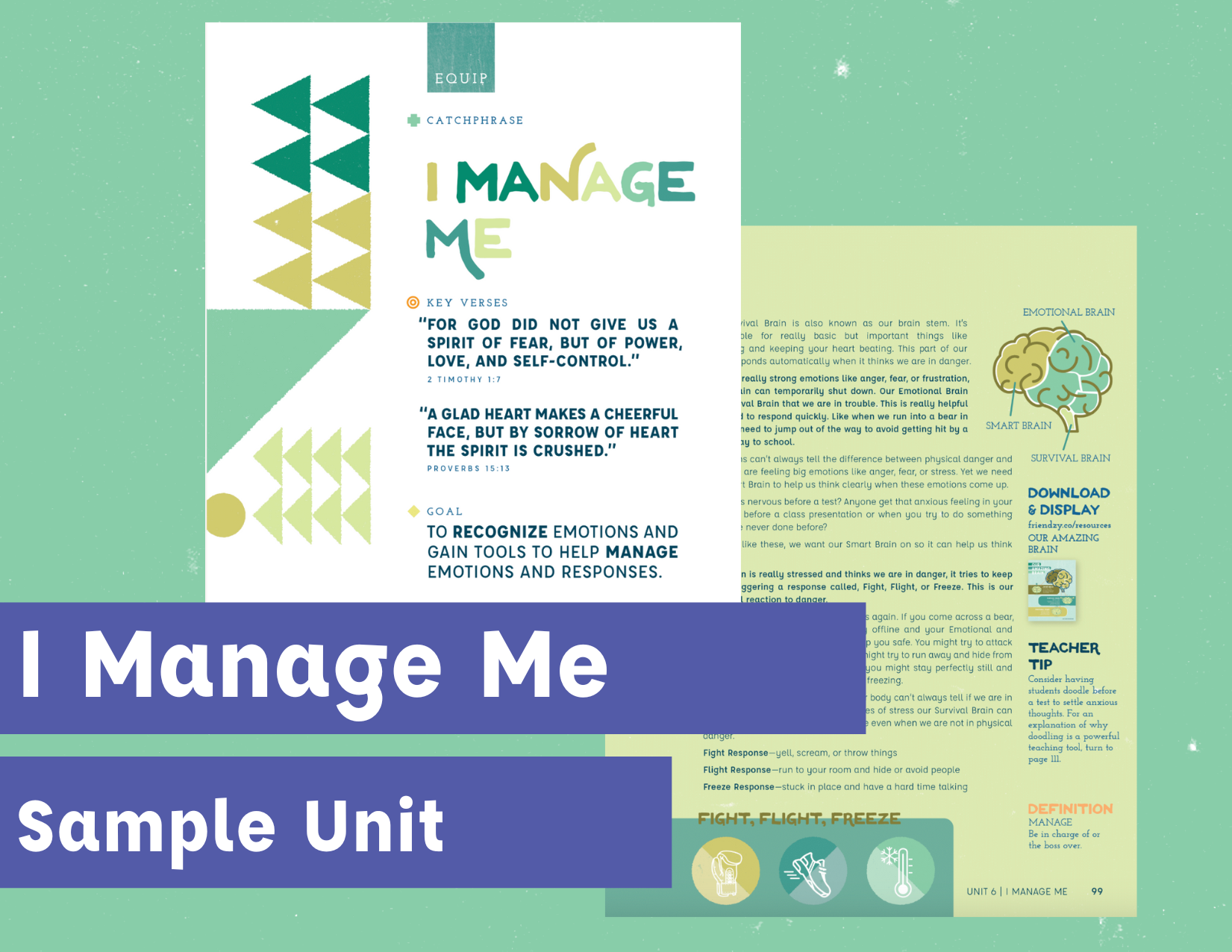
To support this vital work, Friendzy is offering free access to one of our most requested student units: “I Manage Me.” This unit focuses on teaching students practical skills for managing stress, identifying emotions, and building self-control. It’s rooted in current research and reflects our commitment to equipping schools with resources that are both evidence-informed and heart-centered.
As we celebrate Mental Health Awareness Month, we invite you to download this free resource and explore how it can support the students in your classroom or community. Whether you’re an administrator, counselor, teacher, or parent, this unit offers a meaningful way to foster growth, understanding, and connection.
Because behind every outburst is a story. Behind every silence, a need. And behind every student, a strength waiting to be seen.
This unit will help students of all ages identify and regulate their emotions. Students will learn about different parts of the brain and what happens when we feel different emotions. They will practice coping strategies and be introduced to Friendzy’s Daily Check-in Tool, an emotion chart that supports self-awareness.
Use I Manage Me’s lessons to close out the year or when you start fresh in the fall! Lessons should take 20-40 minutes of class time.
Teaching Part 1: Unit Overview - Use this lesson whole-group to introduce the topic and parts of the brain.
Teaching Part 2: Object Lesson - Get tactile in this object lesson that associates emotions with physical items of different textures.
Group Questions - Use these discussion questions to get students talking about real-life examples and reflecting on how they manage their emotions. Students can discuss in pairs, small groups, whole group, or independently reflect on any questions in the lesson. The More Mature Material section is geared towards middle school students.
Activity: Feelings Emojis - Activate students’ creativity with art supplies to create their own emojis.
Game: Paul AND Timothy - Students work in pairs to lead one another through an obstacle course to different emotion posters. Play this game when you have space for students to roam.
Even More - Practice faith in action in this lesson as students unpack James 1:19 in connection to managing one’s emotions.
Citations:
Salerno, J. P. (2016). Effectiveness of universal school-based mental health awareness programs among youth in the United States: A systematic review. Journal of School Health, 86(12), 922–931. https://doi.org/10.1111/josh.12461
Substance Abuse and Mental Health Services Administration. (2023). Key substance use and mental health indicators in the United States: Results from the 2022 National Survey on Drug Use and Health (HHS Publication No. PEP23-07-01-005, NSDUH Series H-58). U.S. Department of Health and Human Services. https://www.samhsa.gov/data/sites/default/files/reports/rpt42731/2022-nsduh-main-highlights.pdf
Yu, M., Johnson, K. E., & Leslie, L. K. (2022). School-based interventions for mental health promotion and problem prevention in children and adolescents. Journal of Child and Family Studies, 31(4), 873–887. https://doi.org/10.1007/s10826-021-02062-4
Zhang, W., Sun, X., & Yu, G. (2022). Multi-tiered systems of support for school mental health: A research review. School Psychology International, 43(1), 3–23. https://doi.org/10.1177/01430343211035662
BIO | Julie Widman Ed.D. - Friendzy Co-Founder

Julie Widman is the co-founder of Friendzy. As a mother and educator, she has witnessed firsthand the growing crisis of social disconnection among children. With the rise of smartphones, kids have become the most technologically connected yet socially disconnected generation, often struggling to navigate real-life friendships.
Determined to make a difference, Julie and her team explored the research behind character education and its critical role in child development. From this deep need, Friendzy was born—a PreK-8 program for faith-based and public schools that strengthens relationship skills, fosters meaningful connections, and builds strong, supportive communities.
Julie holds a Master’s and Bachelor’s degree from the University of Washington and a Doctorate in Educational Leadership from the American College of Education. She is passionate about equipping the next generation with the tools they need to form lasting friendships and thrive in a connected world.