For decades, emotional intelligence (EQ) often has been boiled down to a simple idea: “Be nice.” As well-intentioned as this line of thought is, this oversimplification misses the heart of what EQ really is—and what it looks like when lived in action, especially in today’s classrooms.
By: Joy Roberts| Friendzy Co-founder
At Friendzy, we teach that emotional intelligence is about far more than mere politeness or playing it safe. True EQ is about being genuine—about showing up with integrity, awareness, and courage in the face of life’s complexities.
And life is full of complexities and paradoxes. Meaning, that life is filled with moments that require us to hold space for tension: between speaking and listening, leading and learning, confidence and humility. The strength of an emotionally skilled person isn’t in choosing one or the other. It’s in learning to carry both.
Here are some of the powerful both/and truths that define emotionally intelligent individuals:
You can feel angry and still choose a healthy response.
You can express empathy and still maintain healthy boundaries.
You can identify your feelings and still be surprised by them sometimes.
You can be confident and still admit you don’t know.
You can remain calm and still feel stress internally.
You can expect respect and still lead with it first.
You can listen without judgment while still challenging harmful ideas.
You can share your struggles and still lift others up.
You can hold people accountable and still believe in them.
You can trust your gut and still believe the facts.
You can have strong opinions and still stay open to change.
You can lead with kindness and still make difficult decisions.
This is the kind of emotional intelligence that’s not just helpful—it’s transformative.
By now, you’re probably thinking, “What does this look like in my school?” In our program, we help students learn to name their emotions, take perspective, and respond with self-control through units like our “I Manage Me.” We see teachers modeling vulnerability, practicing empathy, and equipping students with tools to navigate conflict and build community.
We see a shared understanding—that EQ and character development aren’t just about managing behavior. It’s about shaping hearts and minds for healthy relationships and purposeful living in the classroom and beyond.
A student who understands that they can be upset and still make a kind choice is a student who’s empowered with skills for good, skills for life. A teacher who leads with grace and holds students accountable is a teacher shaping future compassionate leaders.
This is emotional intelligence in action. And it matters—because these skills don’t just lead to better test scores or collaborative classrooms—which is an added benefit! They build cultures of trust, resilience, and character.
It’s crucial to model healthy emotional intelligence for our students and show them that navigating the tension of both/and situations can be their superpower. Let’s teach them that real emotional intelligence often looks like humility, balance, and courage under pressure.
Let’s give them permission to feel, reflect, and respond. Let’s model what it means to lead in the tension because that’s not a weakness.
That’s a superpower!
At Friendzy, our approach to character development education is deeply rooted in emotional intelligence and literacy. We believe these aren’t merely "soft skills," they're skills for good, skills for life. The ability to hold tension, to live in the both/and, is what sets healthy classroom cultures apart compared to schools not providing specific character development education.
We teach students that being emotionally aware doesn’t mean being passive or always agreeable. It means using critical thinking, being intentional, and remaining anchored in who you are—even when emotions are high or the path forward is uncertain.
We also equip educators with the tools and language to model and teach these truths. Because when we, as adults, can embody strong EQ in our leadership, we make it safe for the next generation to do the same.
👉 Reach out now to schedule a conversation — we’d love to share how Friendzy can support your school community!
Let’s work together to empower your staff and students with skills for good, skills for life.
Rooting for you and your students,
Joy Roberts | Friendzy Co-Founder | [email protected]
This unit will help students of all ages identify and regulate their emotions. Students will learn about different parts of the brain and what happens when we feel different emotions. They will practice coping strategies and be introduced to Friendzy’s Daily Check-in Tool, an emotion chart that supports self-awareness.
Use I Manage Me’s lessons to close out the year or when you start fresh in the fall! Lessons should take 20-40 minutes of class time.
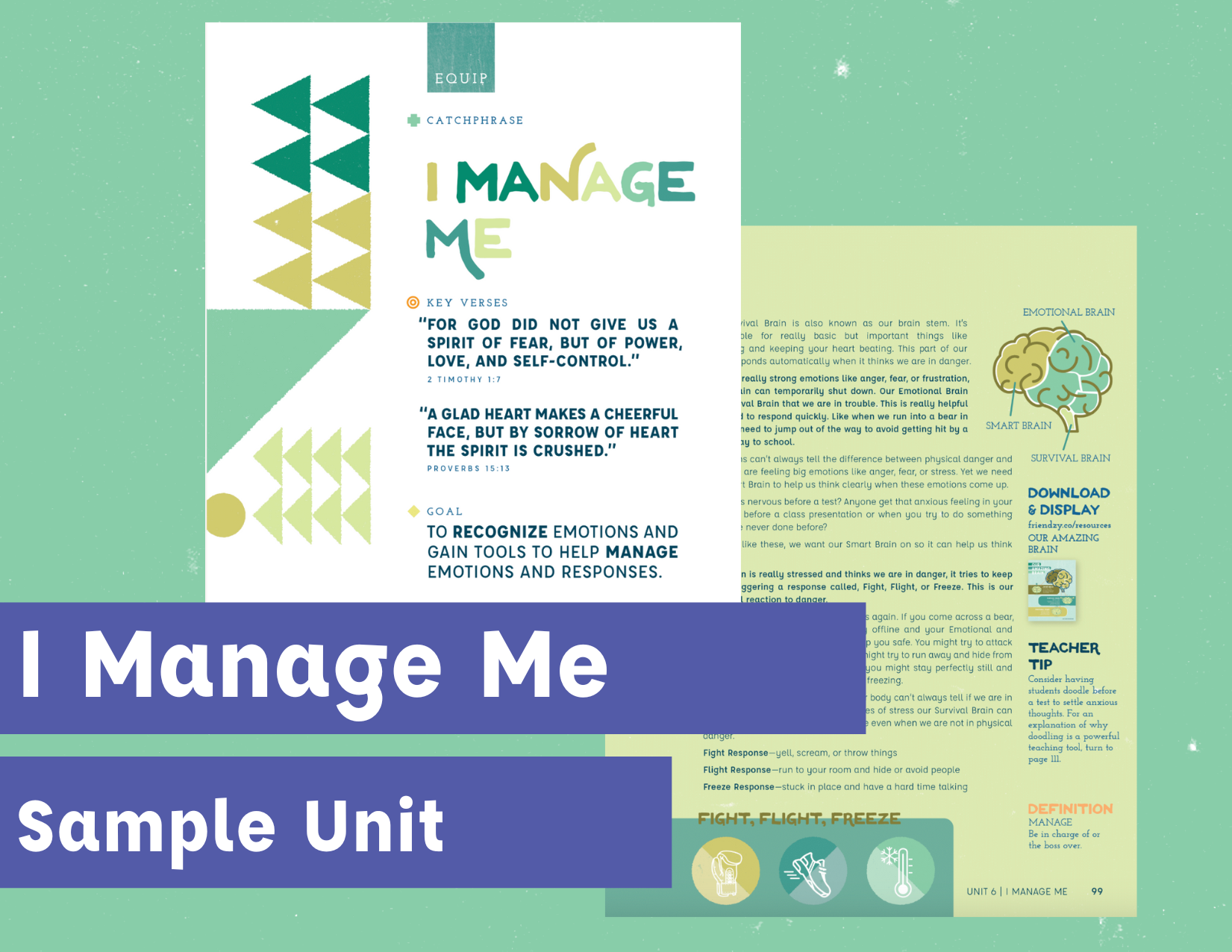
Teaching Part 1: Unit Overview - Use this lesson whole-group to introduce the topic and parts of the brain.
Teaching Part 2: Object Lesson - Get tactile in this object lesson that associates emotions with physical items of different textures.
Group Questions - Use these discussion questions to get students talking about real-life examples and reflecting on how they manage their emotions. Students can discuss in pairs, small groups, whole group, or independently reflect on any questions in the lesson. The More Mature Material section is geared towards middle school students.
Activity: Feelings Emojis - Activate students’ creativity with art supplies to create their own emojis.
Game: I Feel Who Feels - A take on the common classroom game “I Have, Who Has,” students will identify and model emotions using a Friendzy card deck.
Even More: This cross-curricular lesson connects the science of boiling water to the big emotions and reactions we might experience.
Citations:
This blog post was inspired by a reflection on emotional intelligence originally shared by leadership coach Justin Wright, Founder & CEO of Stealth Startup in a LinkedIn group post. View the original post on LinkedIn here.
This blog post was inspired by insights from Six Seconds (Emotional Intelligence Network), a global nonprofit organization dedicated to growing emotional intelligence through research, assessments, and training. Learn more at 6seconds.org.
BIO | Joy Roberts - Friendzy Co-Founder

Joy Roberts is a passionate entrepreneur, curriculum designer, speaker, teacher, character development advocate, and co-founder of Friendzy. Witnessing the growing disconnect among children in an increasingly digital world, Joy and her co-founder, Julie Widman, set out to address the social crisis affecting today’s youth.
In a world where loneliness, isolation, and unkind words are commonplace, she is committed to equipping a generation of students on how to be really good friends. By integrating research-backed, whole-school programming into both faith-based and public schools, Joy guides Friendzy toward fostering character development while strengthening school communities.
With a Bachelor’s in Business Management and Marketing from Washington State University, a Master’s in Theology from Western Seminary, and a Doctorate in Educational Leadership from Marymount University, Joy combines her expertise in education, leadership, and faith to empower students, educators, and families with the tools needed to build meaningful, lasting relationships.